

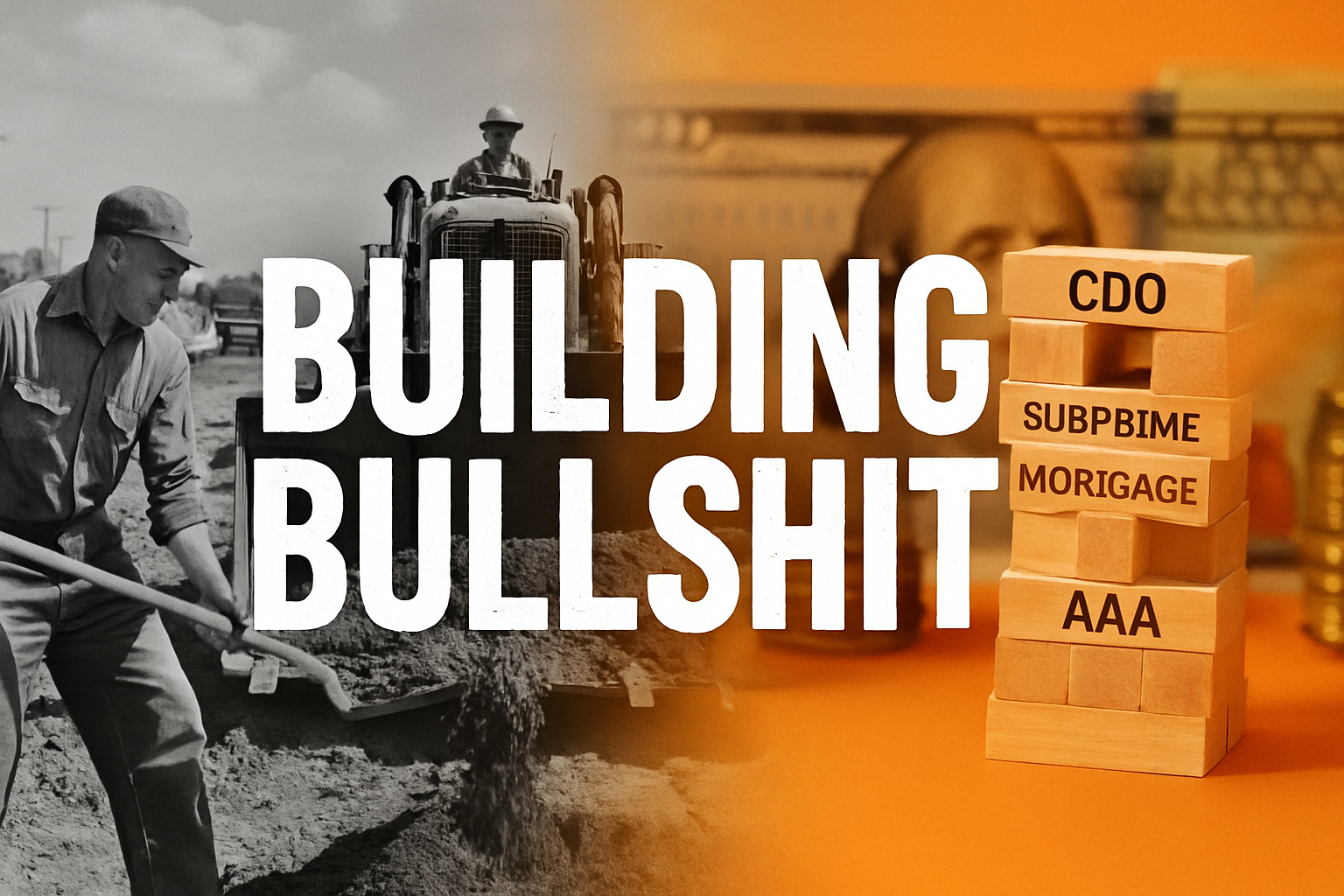
America has gone from a nation driven by tens of millions of builders to a nation steered in a shit direction by a handful of hedge funds and bankers. As a result, we stopped building the future and started building bullshit financial products.
I'll tell ya, if you ever feel your outrage about what's happened to America starting to slip, rewatch "The Big Short." I did last night, and let me tell you, I was instantly reminded of just how badly we botched that moment.
The movie does an amazing job of showing the new American manufacturing sector. The products we build now just aren't useful to many people. It ain't bridges or hospitals, but nonsensical financial products leveraged to an insane degree. CDOs, synthetic CDOs, credit default swaps—a tower of abstract gambling that collapsed and crushed millions of real lives underneath.
There are no heroes in that story—just gradients of how people deal with a terrible system—from those who saw the collapse coming and bet against America to the blind cheerleaders who couldn't see past their bonuses.
America used to build actual things, though. We did.
Not finance things. Not regulate things. Not provide tax credits for things. We built them.
My grandfather rose from sharecropper to farm owner in one generation. The hospital in my hometown belonged to the community—it was literally called Morristown-Hamblen Hospital, not "UnitedHealthProfitCenter #247." The Tennessee Valley Authority didn't just subsidize power—it constructed dams and electrified rural America with its own hands.
This wasn't the government as a referee. It was the government as a builder. A doer and a competitor.
When the 2008 financial crisis exposed the rot, millions lost their homes while the architects got bonuses. What did we do? Nothing that mattered. No executives went to jail. Banks weren't broken up—they got bigger. Those deadly financial products? Still trading. Glass-Steagall? Still repealed.
Obama had his Roosevelt moment and flinched. Democrats bailed out Wall Street while homeowners drowned in foreclosure notices. The message was clear: we manage financial systems, we don't build prosperity.
This transformation wasn't inevitable. The Democrats who run the party today—Schumer, Pelosi, and the rest—formed their political identities when Reagan was declaring government the enemy and Clinton was surrendering to that idea. They've been steeped in Reaganism so long they've forgotten there was ever an alternative.
They internalized the lesson: don't defend government's capacity to build; manage decline instead.
That's why today, as Trump and Musk slash government agencies, Democrats can only sputter about "efficiency" and "waste." Some, like Warren, even cheer parts of it on. They can't articulate why these institutions matter because they themselves forgot.
When climate scientists at NOAA describe being fired, rehired, and fired again as "limbo," Democrats note it's chaotic but fail to explain why a robust NOAA matters—not just to regulate or warn, but to actively build climate resilience.
When 34,000 IRS employees are being lost, Democrats mention reduced tax collection but don't connect that revenue to a vision of what government should build.
We've created a system where money chases money in endless circles, completely divorced from building anything of value. My uncle once took a job as a bag boy with the local A&P and made enough for an apartment and a new Camaro. That world didn't disappear by accident—it was dismantled by policy choices Democrats either championed or failed to fight.
Democrats talk about globalization, automation, and financialization like they're hurricanes—unstoppable forces of nature. But these aren't natural phenomena. They're the results of trade deals, tax codes, and regulations that human beings created and could change.
We didn't build America's infrastructure so billionaires could give Katy Perry a joyride to space. Our water, airwaves, and electrical grid belong to us. We built them.
If Democrats want to lead again, they need to stop defending bureaucracy and start championing what government could build: a clean energy grid, climate-resilient infrastructure, next-generation transportation, advanced manufacturing in forgotten communities.
People always ask me, "What's the solution?" My answer stays consistent: change who holds power—not just in the White House, but in Congress. That's where the real power lives.
I've spent years fighting for that change—from Bernie's campaigns to co-founding Justice Democrats and standing with AOC. Has it worked completely? Not yet. But revolutions take time.
Good people hesitate to run because there's too little support and too much dysfunction. They go to DC, try to do the right thing, and get kneecapped before they can stand.
If we want a different future, we need to back better people—not just on election day, but every day after. They need to know we've got their backs when they get there.
A united Congress with vision and courage can bulldoze bureaucracy, outmaneuver corporate interests, and rebuild America directly. We don't need more policy papers or TED talks. We need different people in power.
The world we live in wasn't handed down by fate. It was built—and unbuilt—by choices. In a system designed to manufacture cynicism, the most radical act is to believe we can build something better.
-Corbin
Postscript
People always ask, “What’s the solution?” Whether we’re talking about healthcare, genocide, mass shootings, or our hollowed-out economy, my answer is the same: change who holds power. Not just the White House—Congress. That’s where the real power lives in this system.
I’ve spent years fighting for that change. I worked on both of Bernie Sanders’ presidential campaigns. I helped found Brand New Congress to replace incumbents. I co-founded Justice Democrats. I stood with AOC, first on the campaign trail, then in Congress. Has it worked yet? Not fully. But just because a revolution hasn’t succeeded yet doesn’t mean it’s wrong.
People ask, “Where are the leaders? Why don’t good people run for office?” The answer hurts: there’s too little support and too much dysfunction. Good people go to DC or the state house, try to do the right thing, and get kneecapped before they can stand.
If we want a different future, we have to back better people. Not just on election day—but every day after. They need to know we’ve got their back, and that they won’t stand alone once they get there.
A united Congress with a clear vision and a willing president can bulldoze bureaucracy, outmaneuver corporate lobbyists, and override elite resistance. We don’t need more policy memos or TED Talks. We need different people in power. And in this country, that still starts with Congress.
COMMENTS
Loading comments...