

03/10/2025 Substack - A Massive American Pay Cut
The Economic Collapse That Created Trump
For most of our lives, we’ve been told a simple story: The economy is growing. Wages are rising. Each generation is better off than the last.
The economists, the media, and the politicians in both parties all swear by it. After all, the “real wages” numbers prove it. We’re richer than our parents, grandparents, and even the Greatest Generation.
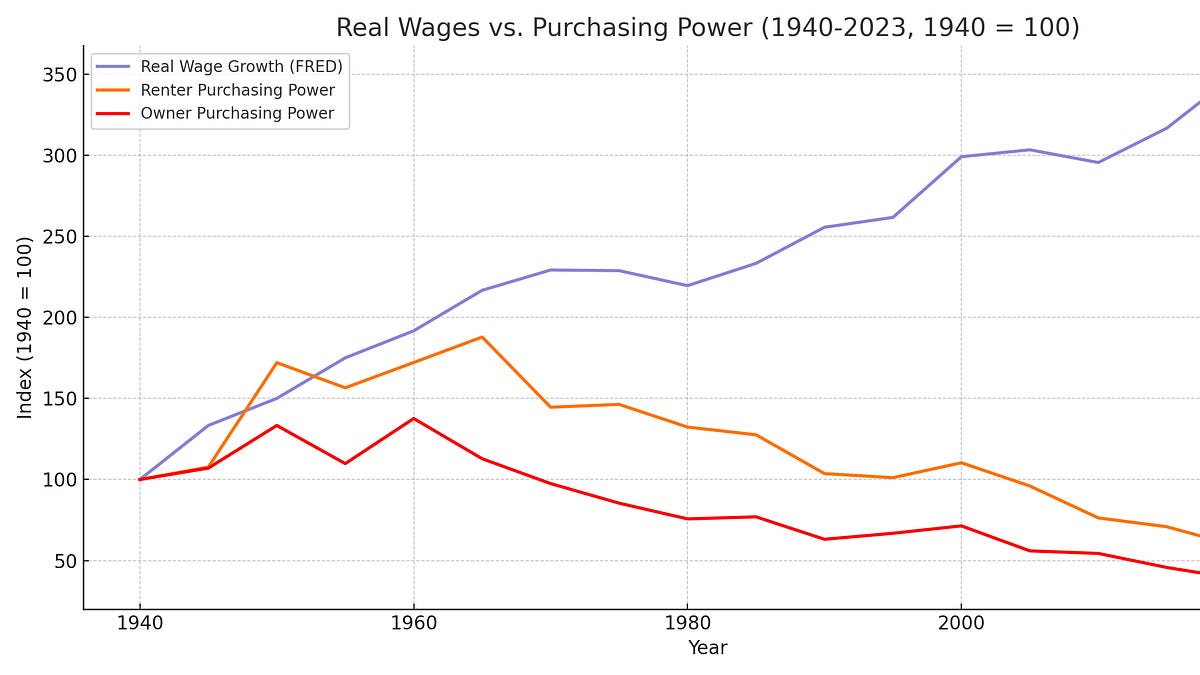
They lie. The blue line is the official “real wage,” and the other lines show what happened to renters’ (orange) and homeowners’ (red) purchasing power. I show the math later.
Wages are up on paper, but purchasing power has collapsed. Renters and homeowners have lost ground for decades.
Wages aren’t stagnant—they’re in free fall. Since World War II, every generation has been handed a worse deal than the one before it. What one paycheck could buy in 1950 now takes two, sometimes three, and even that’s not enough. College tuition required a summer job in 1970—now it demands decades of debt.
Two incomes today buy less than one in 1950.
Shows two full-time workers today have less purchasing power than a single worker did in 1950. The red line marks the 1950 baseline—when one paycheck could support a family. The green line is where two incomes should be if wages had kept up. Instead, purchasing power peaked in the 1960s and has crashed ever since.
A middle-class life—once achievable on one income—now takes two, and even that isn’t enough.
Official statistics don’t just fail to capture this decline—they actively disguise it.
A headline from March 7th maintains that we had been living in a solid economy.
Inflation is rigged, wages are manipulated, and GDP growth doesn’t mean prosperity—it means desperation. We measure economic success by how much debt we take on just to survive.
And in the wreckage of this hidden collapse, stepped Donald Trump.
How Much Work Does It Take?
Healthcare:
Our grandparents worked ONE WEEK for a year of healthcare.
We’re working TWELVE WEEKS for the same thing.
Buying a house?
Our grandparents earned enough in THREE YEARS to buy a home outright.
We need more than TEN YEARS to afford a median home.
College?
It used to take a few months of work. Now? More than a year.
Childcare?
Went from two months’ wages to SIX months’ of wages.
These lines should be going DOWN!
Trump didn’t cause this economic disaster—he exploited it. He saw the anger, the despair, the realization that the American Dream had become a scam, and he weaponized it. He told people their pain was real. That the system was rigged. That their leaders had failed them. And unlike the economists, the politicians, and the media, he never told them to “learn to code” or “stop whining.”
That’s why he won. That’s why he’s still here. And that’s why the same system that paved the way for his rise is still failing the majority of Americans today.
But let’s be clear: Today’s Democrats aren’t the answer either.
They don’t see the collapse because their numbers tell them it doesn’t exist. They still cling to the fantasy that wages are rising, and our economic system is sound. That GDP growth means working Americans are doing better. They are incapable of fixing a crisis they can’t even acknowledge.
So Trump has seized the economic anxiety Democrats refuse to see. He’s pushing solutions that won’t work, that will likely make things worse, but at least he’s talking about it. And that’s enough for millions of people who have spent decades being ignored.
This is the truth that official statistics hide. The numbers below tell the real story. Once you see them, you won’t be able to unsee them.
Official statistics tell us that American workers are better off than they have ever been.
That’s a lie.
We’ve actually lost two-thirds of our purchasing power since 1950.
Sound unbelievable? In our grandparents’ America one job bought a decent life. You could thrive, not just survive, on ONE income. We’re talking a house, cars, kids, college, healthcare, retirement—the whole shebang.
Nowadays? You’d need three full-time jobs to match what one job bought back then. This isn’t a theory. This is straight math about how much we could buy with a year of our working lives.
How did I come to such a wild conclusion?
I looked at official government data—median incomes from the IRS and Census Bureau, actual prices for a basket of essentials from HUD and other federal records—and compared what things really cost in 1940 versus today. No complex adjustments, no convoluted formulas. Just straight math: how many years, weeks, or months of work does it take to buy the basics?
I call this “Years of Work” (YoW)—a direct measure of how much life you trade for necessities. And it tells us more about economic reality than any inflation-adjusted statistic. The study is here, the methodology here, and the data set here.
So, that $42,220 median income you’re earning today? To match what our grandparents could actually buy in 1950, you’d need to make $102,024.
This isn’t just about prices going up—it’s about how much our paycheck can actually buy.
And since 1965, wages haven’t just stopped rising—they’ve been falling, and falling hard, when it comes to essentials like housing, healthcare, education, and the basics we all need.
See the full breakdown of the data and methodology.
The government claims “real wages” have increased 252% since 1950.
But my calculator says we’ve lost 61% of our purchasing power.
Both can’t be true.
Either basic math is wrong, or their unnecessarily complex statistics have become completely detached from reality.
When my uncle graduated from high school, he took a job as a bag boy with the local A&P. He made enough money to pay for an apartment, eat, drink, be merry—and have a new Camaro.
My aunt went to ETSU and worked a part-time job, graduating with no debt while paying her way as she went.
Imagine that.
Imagine how hard that makes it for generations to relate to one another. They live in different realities.
Instead of counting what housing actually costs, the government created “owners’ equivalent rent.”
And how do they arrive at this number?
They call homeowners on the phone and ask them to guess what their house would cost if they rented it.
I’m not kidding.
They tell you a $48,000 car is actually cheaper than our grandfather’s $860 car because it has better features.
It’s a complex formula that turns price increases into paper discounts.
Try explaining that math to your bank when the payment comes due.
The Biggest Heist in American History
Every time something gets more expensive—healthcare, college, childcare—GDP goes up.
Every time families go deeper into debt just to survive, GDP grows.
In 1950, household debt was only $47 billion. Today it exceeds $17.1 trillion. When measured in years of work required at median wages, each person’s share of the total debt burden has grown from eight weeks of work in 1950 to 63 weeks today—a 670% increase in the human time-cost of debt.
Debt burden measured in work-years has tripled since 1980. What once took one year of labor now demands over three—a survival mechanism, not prosperity.
Every time both parents are forced to work instead of one having the choice to stay home, GDP rises.
They’re measuring our desperation and calling it growth.
We used to build things in this country. Real things. Roads, bridges, power grids that transformed lives.
When we invested in ourselves, everybody got richer—not just the folks at the top.
We can do that again. But first, we have to be honest about where we are.
GDP grows when they take more from us.
Stock markets soar while families drown in debt.
“Real wages” rise on paper while buying power crashes in real life.
See the full data set and methodology.
The choice is simple:
We can keep measuring success by numbers designed to hide our decline—or we can start building an economy that actually serves the people who make it work.
Because right now?
We’re not just declining.
We’re being stripped for parts.
And no amount of statistical manipulation can hide that theft anymore.
The Massive American Pay Cut isn’t just a one-off analysis. It’s the first in a series examining how we got here and what we can do about it.
In the coming weeks, I’ll be exploring:
How our measures of economic progress became detached from reality
Which policies drove this massive transfer of wealth upward
What specific changes would reverse the decline
We aren’t just identifying the problems—we are building the roadmap back to an economy that works for everyone.
Share this with anyone and everyone
Subscribe to follow the full series on America’s hidden economic collapse
We can build something better—but first, we need to understand what we’ve lost.
COMMENTS
Loading comments...